-
By admin
-
15 6 月, 2026
- 0 Comment
Precision Machining for Hydrogen Energy Systems: Materials, Challenges, and Solutions
Meta description: Discover how precision machining enables hydrogen energy systems — from fuel cell bipolar plates to electrolyzer frames. Explore key materials, manufacturing challenges, and proven engineering solutions.
The global shift toward a clean-energy economy is reshaping manufacturing. At the center of that transformation sits hydrogen — the most abundant element in the universe — and the precision-machined components that make it usable. From green-hydrogen electrolyzers to fuel cell stacks and high-pressure storage vessels, every critical part in a hydrogen energy system depends on micron-level accuracy.
In this guide, you’ll learn what precision machining for hydrogen energy systems really involves, which materials engineers rely on, where production hits its hardest walls, and which solutions the industry is using to break through.
1. Why Hydrogen Energy Systems Demand Ultra-Precision Machining
Hydrogen is the smallest and lightest molecule on the periodic table. That is great for energy density — and brutal for engineering tolerances. A few key facts explain the precision requirement:
- Hydrogen embrittlement can crack metals that are “good enough” for most other industries.
- Leak rates as small as 0.001 sccm can compromise an entire fuel cell stack.
- Stack efficiency drops sharply when bipolar plate flow-field channels deviate from design by more than 10–20 microns.
- High-pressure storage (350–700 bar) leaves zero margin for thread, seal, or wall-thickness variation.
Whether you’re producing PEM electrolyzers, alkaline electrolyzers, proton-exchange-membrane fuel cells (PEMFC), or Type IV hydrogen storage tanks, precision CNC machining isn’t optional — it’s the foundation of safety, performance, and ROI.
2. Key Materials Used in Hydrogen Component Manufacturing
Selecting the right alloy is the first decision. Each material brings a different mix of machinability, corrosion resistance, and hydrogen compatibility.
2.1 Stainless Steel 316L
- Why it’s used: Excellent corrosion resistance, low cost, good weldability.
- Typical parts: Bipolar plates, electrolyzer frames, manifolds, valve bodies.
- Machining note: Work-hardens rapidly — use sharp carbide tools, low cutting depths, and abundant coolant.
2.2 Titanium (Grade 1, 2, 5 / Ti-6Al-4V)
- Why it’s used: Outstanding strength-to-weight ratio and superb hydrogen compatibility.
- Typical parts: Bipolar plates for fuel cells, lightweight hydrogen storage liners, aerospace fuel system components.
- Machining note: Low thermal conductivity generates high heat — use high-pressure coolant and TiN-coated tools.
2.3 Aluminum Alloys (6061, 7075)
- Why it’s used: Lightweight, high thermal conductivity, cost-effective for high-volume production.
- Typical parts: Heat exchangers, fuel cell end plates, hydrogen cooling manifolds.
- Machining note: Avoid galling; use polished flutes and high spindle speeds.
2.4 Inconel and Other Nickel-Based Superalloys
- Why it’s used: Extreme temperature and pressure tolerance, exceptional corrosion resistance.
- Typical parts: High-pressure hydrogen valves, reformer components, turbine components in hydrogen-burning engines.
- Machining note: Abrasive and tough — use ceramic or coated carbide tools with rigid setups.
2.5 Carbon Fiber Composites with Polymer Liners
- Why it’s used: Lightweight, hydrogen-permeation-resistant (with proper liner).
- Typical parts: Type IV hydrogen storage tank bodies.
- Machining note: Hybrid machining (composite + metal boss interfaces) requires diamond tooling and dust extraction.
2.6 Coated and Plated Steels
- Why it’s used: Gold, silver, polymer, or amorphous-carbon coatings reduce contact resistance and prevent oxidation on bipolar plates.
- Typical parts: Coated metal bipolar plates for fuel cell stacks.
- Machining note: Machining is typically done before coating; masking and fixturing are critical.
3. Critical Hydrogen Components That Require Precision Machining
| Component | Function | Typical Tolerance | Common Process |
|---|---|---|---|
| Bipolar plates (PEM electrolyzer / fuel cell) | Distribute gas & current, manage heat | ±0.02 mm, Ra < 0.8 μm | 5-axis CNC milling, micro-machining |
| Electrolyzer frames & end plates | Hold stack together, seal cells | ±0.05 mm flatness | CNC milling, large-format machining |
| Hydrogen storage cylinders (Type III/IV) | Store compressed H₂ at 350–700 bar | Tight thread, ±0.1 mm wall | CNC turning, multi-axis milling |
| Valve bodies & fittings | Control flow, prevent leaks | ±0.01 mm sealing surfaces | Swiss turning, EDM |
| Hydrogen compressors | Boost pressure for storage/transport | Precision bores, dynamic balance | CNC turning, cylindrical grinding |
| Heat exchangers & intercoolers | Manage thermal load | ±0.025 mm on tube sheets | CNC drilling, tube-expanding |
4. Top Challenges in Precision Machining for Hydrogen Energy
Even with the right equipment, hydrogen component manufacturing is unforgiving.
4.1 Hydrogen Embrittlement
Hydrogen atoms diffuse into metal lattices, causing cracking under sustained load. The challenge: preventing embrittlement during service is impossible — controlling it requires material selection, surface treatment, and process control.
4.2 Extremely Tight Tolerances
Flow-field channels on bipolar plates are often 0.5–1.0 mm wide × 0.5 mm deep with ±10 µm accuracy. Any deviation hurts cell efficiency.
4.3 Surface Finish Requirements
Sealing surfaces need Ra < 0.4 µm. Bipolar plate surfaces need low contact resistance without coatings that add cost.
4.4 Material Work Hardening
316L and titanium work-harden quickly, dulling tooling and risking thermal damage to the part.
4.5 Scaling Production
Lab-scale precision is achievable. Producing tens of thousands of identical fuel cell stacks per year at aerospace-grade quality is the real hurdle.
4.6 Leak Prevention
Every threaded interface, flange, and weld is a potential leak point. Hydrogen’s tiny molecule escapes through paths other gases can’t.
4.7 Mixed-Material Assemblies
Type IV tanks combine carbon fiber, polymer liners, and metal bosses — each material machines differently, with different tolerance stack-ups.
5. Proven Engineering Solutions
Here’s how leading manufacturers are solving these challenges today.
5.1 Multi-Axis CNC Machining Centers
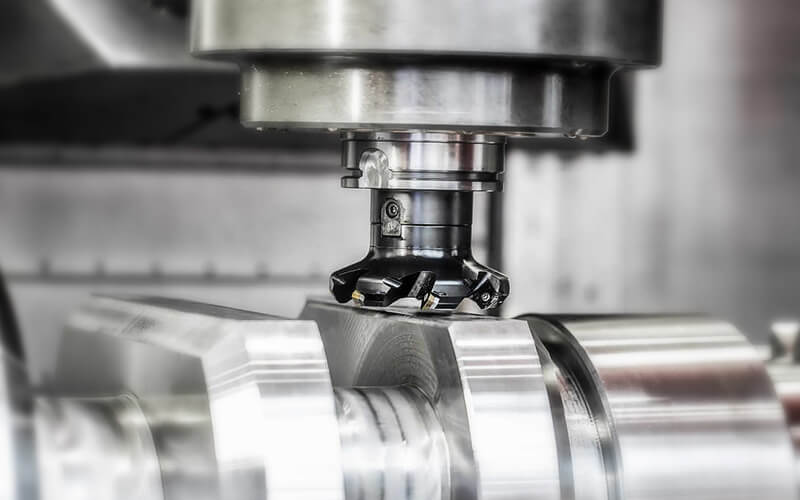
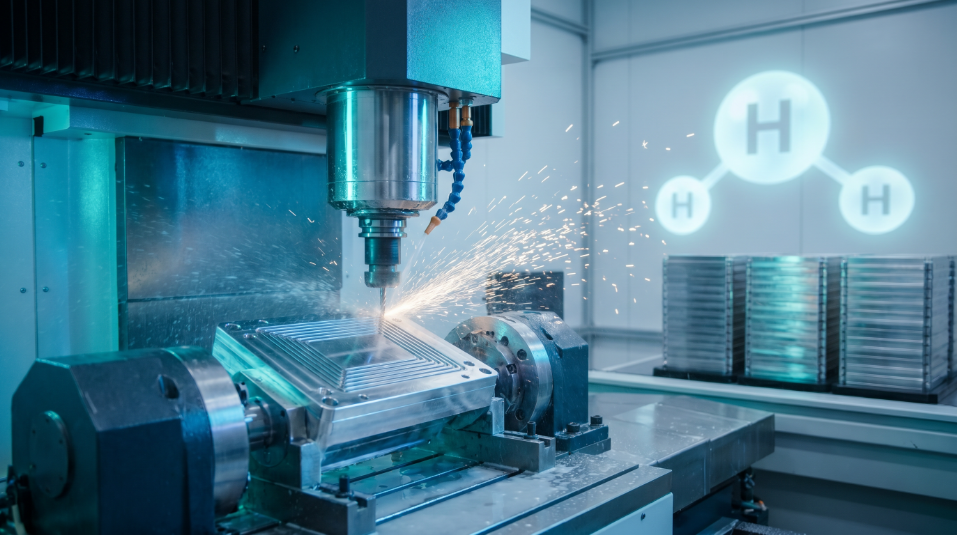
5-axis simultaneous machining reduces setups, improves accuracy, and enables the complex 3D flow fields in bipolar plates. Look for machines with thermal stability and high-rigidity castings.
5.2 Micro-Machining and Micro-EDM
For sub-millimeter features, micro-milling and wire EDM deliver repeatable accuracy without the tool-deflection issues of conventional machining.
5.3 Advanced Tooling
- Coated carbides (TiAlN, AlCrN) for stainless and titanium.
- Diamond-coated tools for composites and aluminum-silicon alloys.
- Custom-form tools that machine a complete flow-field channel in one pass.
5.4 In-Process Metrology
On-machine probing, laser scanning, and vision systems catch drift before parts are scrapped — critical for high-value hydrogen components.
5.5 Specialized Coatings
Post-machining coatings (amorphous carbon, gold, silver, polymer) reduce contact resistance, prevent oxidation, and add a hydrogen diffusion barrier on bipolar plates.
5.6 Hydrogen-Specific Surface Treatments
Processes such as nitriding, shot peening, and electropolishing improve fatigue life and reduce hydrogen uptake at the surface.
5.7 Automation and Lights-Out Manufacturing
Robotic loading, automated tool changing, and AI-driven tool-wear compensation allow 24/7 production with consistent quality.
5.8 Digital Twin & Process Simulation
Simulating the cutting process digitally lets engineers optimize feeds, speeds, and tool paths before metal touches the spindle — saving time and titanium.
6. Quality Control Standards for Hydrogen Components
Precision machining alone isn’t enough. Hydrogen components must be validated against rigorous standards:
- ISO 14687 — Hydrogen fuel quality
- ISO 17268 — Hydrogen refueling connection devices
- SAE J2600 / J2799 — Fueling protocols and connectors
- ASME BPVC Section VIII — Pressure vessel design
- EC79 / GTR 13 — Hydrogen vehicle safety regulations
- ASTM B852 — Electrodeposited coatings for fuel cell bipolar plates
In-house testing typically includes helium leak testing, pressure cycling, burst testing, CT scanning, and surface profilometry.
7. Future Trends in Precision Machining for Hydrogen
The hydrogen economy is scaling fast. Expect these trends to define the next 3–5 years:
8. Choosing a Precision Machining Partner for Hydrogen Projects
If you’re sourcing components for hydrogen energy systems, evaluate potential partners on:
- ✅ Material expertise in 316L, titanium, Inconel, and composites
- ✅ Tolerance capability down to ±0.005 mm with documented CMM reports
- ✅ Hydrogen-specific experience — ask for case studies
- ✅ Quality certifications (ISO 9001, AS9100, IATF 16949)
- ✅ Leak and pressure testing in-house
- ✅ Scalable capacity from prototype to series production
- ✅ Engineering support for DFM (design for manufacturability)
Conclusion
Precision machining is the invisible backbone of the hydrogen economy. Without micron-level accuracy, the bipolar plates that split water, the fuel cell stacks that power vehicles, and the high-pressure vessels that store H₂ simply wouldn’t perform — or worse, wouldn’t be safe.
By selecting the right materials, embracing multi-axis and micro-machining technologies, and pairing them with rigorous metrology and quality control, manufacturers can turn hydrogen’s promise into a commercial reality.
Planning a hydrogen project? Partner with a precision machining team that understands the unique demands of hydrogen energy systems — from prototype to production.
FAQ
What is the most common material for hydrogen bipolar plates? Stainless steel 316L is the industry standard, often coated with amorphous carbon, gold, or polymer to reduce contact resistance and protect against corrosion.
What tolerance is required for fuel cell bipolar plates? Flow-field channel tolerances are typically ±10–20 µm, with surface roughness below Ra 0.8 µm for uncoated plates.
Why can’t standard CNC machining be used for hydrogen components? Hydrogen systems demand tighter tolerances, specialized materials, and leak-free sealing surfaces that go beyond general-purpose CNC work.
How do you prevent hydrogen embrittlement in machined parts? Use hydrogen-resistant alloys, control surface hardness, apply barrier coatings, and follow ASME / ISO guidelines for stress relief and post-machining heat treatment.
Can titanium replace stainless steel in hydrogen applications? Yes, especially where weight matters (aerospace, mobility). Titanium offers excellent hydrogen compatibility but is more expensive and harder to machine.
Looking for a precision machining partner for your hydrogen energy project? Contact us for a technical consultation and quote.
“We can easily manage if we will only take, each day, the burden appointed to it. But the load will be too heavy for us if we carry yesterday’s burden over again today, and then add the burden of the morrow before we are required to bear it factorial non.”
Rebert Kosta