-
By admin
-
17 8 月, 2026
- 0 Comment
Digital Twin Technology in CNC Machining: Simulating Precision Before Production
Introduction: The Next Evolution of Precision Manufacturing
The manufacturing industry is entering a new era where digital intelligence and physical production systems are deeply integrated. For precision CNC machining, achieving exceptional accuracy is no longer limited to advanced machine tools and skilled operators. Modern manufacturers are increasingly adopting digital twin technology to simulate, analyze, and optimize machining processes before actual production begins.
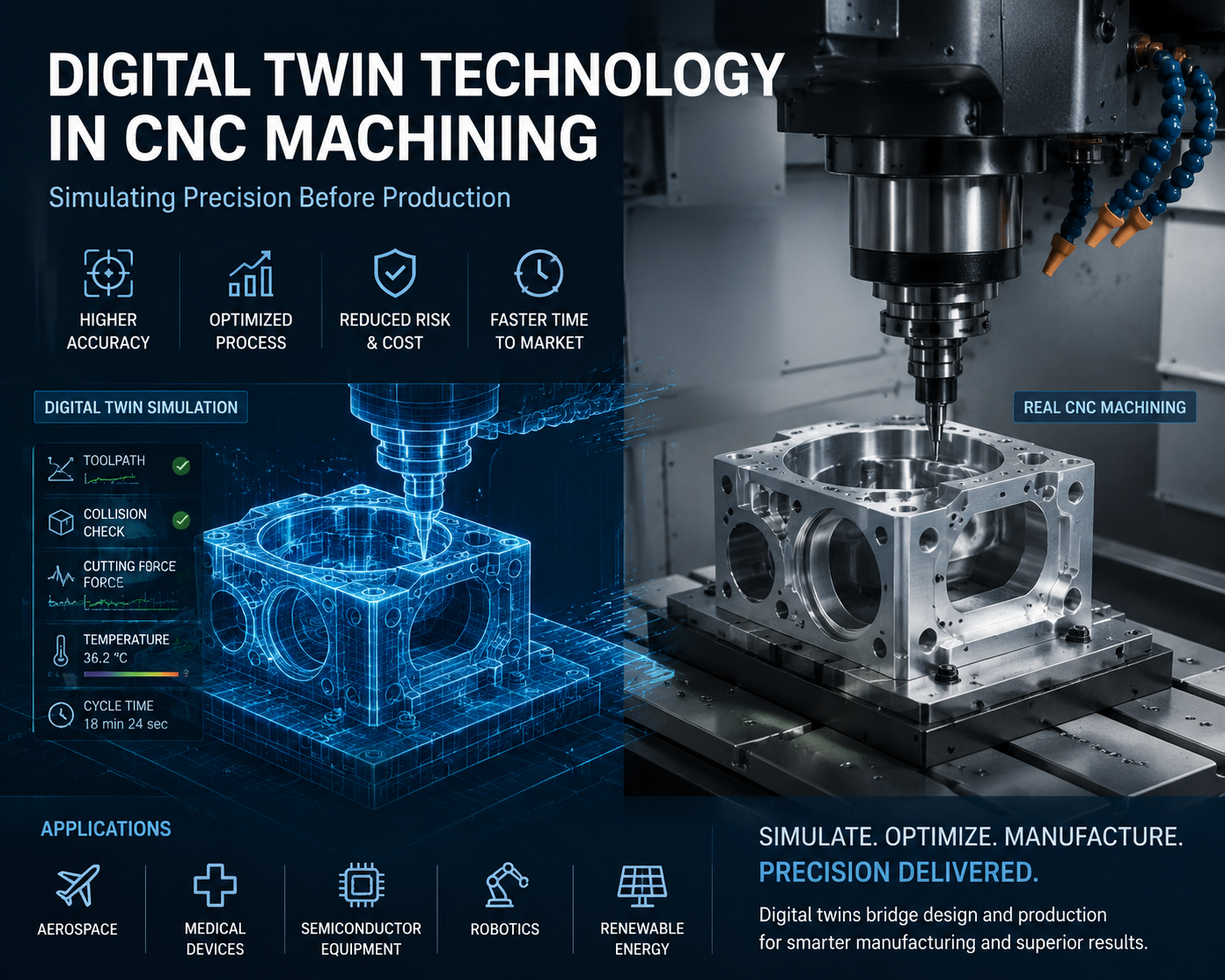
A digital twin in CNC machining creates a virtual replica of the physical manufacturing environment, including machines, tools, materials, cutting parameters, and production workflows. By analyzing real-time data and predicting potential issues, manufacturers can improve accuracy, reduce risks, and accelerate product development.
For industries such as aerospace, medical devices, semiconductor equipment, robotics, and renewable energy, digital twin technology is becoming a key solution for producing complex, high-value components with greater efficiency and reliability.
What Is Digital Twin Technology in CNC Machining?
A digital twin is a dynamic virtual model that mirrors a real-world machining system. Unlike traditional CAD simulation, which only represents part geometry, a CNC machining digital twin integrates multiple layers of manufacturing information:
- 3D part models and CAD data
- CNC machine parameters
- Cutting tools and tool wear conditions
- Material characteristics
- Thermal behavior
- Vibration patterns
- Production process data
Through continuous data synchronization, engineers can evaluate machining performance digitally before committing resources to physical production.
How Digital Twins Improve CNC Machining Accuracy
1. Virtual Machining Simulation Before Production
One of the biggest advantages of digital twin technology is the ability to simulate machining operations before running actual parts.
Engineers can analyze:
- Toolpath movements
- Potential collision risks
- Material removal processes
- Cutting force variations
- Fixture positioning accuracy
This allows manufacturers to identify problems early, optimize CNC programs, and reduce costly trial-and-error processes.
For complex components with multi-axis machining requirements, virtual validation significantly improves production confidence.
2. Optimizing Toolpaths for Higher Efficiency
Traditional CNC programming often requires multiple iterations to achieve the ideal balance between speed and precision.
Digital twins enable engineers to test different machining strategies virtually:
- Cutting speed optimization
- Feed rate adjustment
- Tool engagement analysis
- Step-over optimization
- Cycle time reduction
By selecting the most efficient machining parameters before production, manufacturers can reduce machining time while maintaining strict dimensional requirements.
Predictive Quality Control Through Digital Manufacturing Data
Precision components often require extremely tight tolerances. Digital twin systems help manufacturers move from reactive inspection toward predictive quality management.
By analyzing historical and real-time production data, digital twins can predict:
- Dimensional deviations
- Tool degradation
- Thermal deformation
- Surface quality issues
This enables engineers to make adjustments before defects occur, improving consistency in both prototype and mass production environments.
Digital Twin Applications in High-Precision Industries
Aerospace Manufacturing
Aerospace components such as turbine blades, structural brackets, and engine parts require exceptional accuracy and reliability.
Digital twin technology helps optimize:
- Complex 5-axis machining processes
- Lightweight structural designs
- Difficult-to-machine materials such as titanium and Inconel
Medical Device Manufacturing
Medical components demand strict quality control and repeatability.
Digital twins support:
- Implant manufacturing validation
- Surgical instrument production
- Surface finish optimization
- Traceable manufacturing records
Semiconductor Equipment Manufacturing
Semiconductor equipment requires extremely stable and precise components.
Digital simulation helps control:
- Thermal deformation
- Micro-level positioning accuracy
- Machine stability
Renewable Energy Equipment
For solar, battery, and energy storage industries, digital twins improve the manufacturing process of:
- Aluminum housings
- Cooling structures
- Power module enclosures
- Structural components
From Prototype Development to Mass Production
Digital twin technology creates significant advantages throughout the product lifecycle:
During Prototype Development:
- Faster design validation
- Reduced physical testing cycles
- Improved manufacturability analysis
During Production:
- Higher process stability
- Reduced scrap rates
- Better machine utilization
During Mass Manufacturing:
- Consistent quality across large production volumes
- Predictable production performance
- Continuous process improvement
This makes digital twins especially valuable for companies developing complex products that require rapid innovation and reliable scaling.
The Future of CNC Machining with Digital Twins
As manufacturing continues toward Industry 4.0, digital twin technology will become increasingly connected with:
- Artificial intelligence
- Machine learning
- IoT sensors
- Automated inspection systems
- Smart factory platforms
The future CNC factory will not only produce parts—it will continuously analyze, learn, and optimize every manufacturing decision.
Simulating Precision Before Production
Digital twin technology represents a major transformation in precision CNC machining. By allowing manufacturers to simulate production processes before machining begins, it reduces risks, improves efficiency, and ensures higher levels of accuracy.
For companies requiring complex, high-performance components, partnering with a manufacturer that embraces digital manufacturing technologies provides a significant competitive advantage.
Through the combination of advanced CNC machining, engineering expertise, and intelligent production systems, manufacturers can deliver reliable precision parts faster and more efficiently than ever before.
“We can easily manage if we will only take, each day, the burden appointed to it. But the load will be too heavy for us if we carry yesterday’s burden over again today, and then add the burden of the morrow before we are required to bear it factorial non.”
Rebert Kosta